Asia America Relationships

asia-americaIt is possible that the various internal conflicts within the Asia region are adding to the attractiveness of America. Since there are tensions between Sothern and North Koreans, Bangladeshis have misgivings about Indians, etc. But when it comes to Asia America, trust issues seem to be better. Indeed, a recent survey conducted by Pew has proven this point statistically.

Pew’s Balance of Power Survey found that most respondents in eight Asian countries viewed America as their “chief ally.” Only Pakistan and Malaysia from Asia said they felt they were most comfortable with China in this realm.

The idea that a pro-US and a pro-China camp are both being built up in the region appears to have some traction based on Pew’s research. Two countries that named China as their chief ally also named the US as their main regional threat—as did China itself. Meanwhile, three states that said the US was their primary partner saw China as their nation’s main regional threat.

China on the other hand, does not view America as its closest ally, but rather Russia. This might be somewhat surprising, given the somewhat stressful history between the two nations. Returning to the topic of inter-Asian relations, again Pew found that there wasn’t all that much love lost. A mere 7 percent of Japanese respondents felt positive toward China with 8 percent of Chinese respondents feeling more or less the same about their Japanese counterparts.

Worst faring in the Pew survey was Pakistan, that no-one seemed to like particularly. Indeed, even though a large amount of Pakistanis (57 percent) named China their top ally, only 30 percent of the Chinese were positive about Pakistan.

How about America? How does America feel about Asia? Well, America does need its allies to balance China. But there again this is a two-way street since its allies need China to balance America. As a result of this, Asia-Pacific security has become heavily reliant on America with its economy dependent on China. Long-term this is not the best situation for America. So ultimately America should be deciding whether or not to continue its containment strategy, or work for advancement in Asia-Pacific’s region. So that’s where America is holding right now, vis-à-vis Asia.
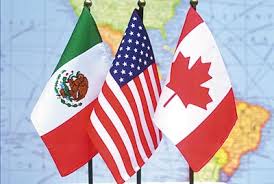
Expanding Asia America Trade Agreements

NAFTABarack Obama has pledged to expand Asia America trade agreements.  Even though he is dealing with some quite heavy duty issues within his own political party, on speaking with Canadian and Mexican policymakers he stressed the importance of the US maintaining its “competitive advantage”. The countries are currently working on a Trans-Pacific Partnership (TPP) which is an agreement between 12 nations that would probably be one of the largest trade deals in the world.

The Three Amigos – the term given to the talks transpiring between the three nations – have each had their fair change of changes in their economies since the previous major trade agreement occurred around 20 years ago – the NAFTA.

It is hoped that these negotiations will result in North America Asia trade relations 20 year bloc being “revitalized.”  Still there are some issues that remain to be taken care of, such as Canada’s refusal to end visa requirements for Mexican visitors as well as the somewhat controversial Keystone XL pipeline project that would bring oil from Canada to Texas but could have a negative environmental impact.  Still if the TPP does go ahead, it could result in US leaders agreeing on labor and environmental standards that were lacking in the NAFTA agreement.

The TPP agreement involves all the NAFTA nations as well as Australia, Brunei, Chile, Japan, Malaysia, New Zealand, Peru, Singapore and Vietnam.  This figure comprises 40 percent of the global economy.

Asia America Ties

Truong_Tan_SangStronger ties are developing with Asia America.  The US is indicating a more substantial commitment to Asia in recent times.  This was particularly noticeable when, at the end of July, President Barack Obama hosted the Vietnamese President, Truong Tan Sang at the White House. The meeting was particularly poignant since it happened four decades after the end of America’s military involvement in the Vietnam War. As well, this is a time of advancing ties in security and trade with Asia America, via Washington and Hanoi.

President Obama said that he understood Asia America’s “extraordinarily complex history.”  Further, the two regions have developed “mutual respect and trust,” and it is hoped that this will advance even more on economic as well as military issues in the future.

Some of the subjects discussed at the meeting included: the Trans-Pacific Partnership; South China Sea maritime disputes; climate change; human rights and economic ties.    Vis-à-vis the partnership, Obama said, “we’re committed to the ambitious goal of completing this agreement before the end of the year because we know that this can create jobs and increase investment across the region and in both our countries.”

At the conclusion of the meeting, President Obama said:


“So I just want to say to President Sang how much I appreciate his visit. I think it signifies the maturing and the next stage of the development between the United States and Vietnam. As we increase consultation, increase cooperation, increase trade, and scientific and education exchanges, ultimately, that’s going to be good for the prosperity and opportunities of the people here in the United States, as well as good for the opportunities and prosperity of the people of Vietnam.”